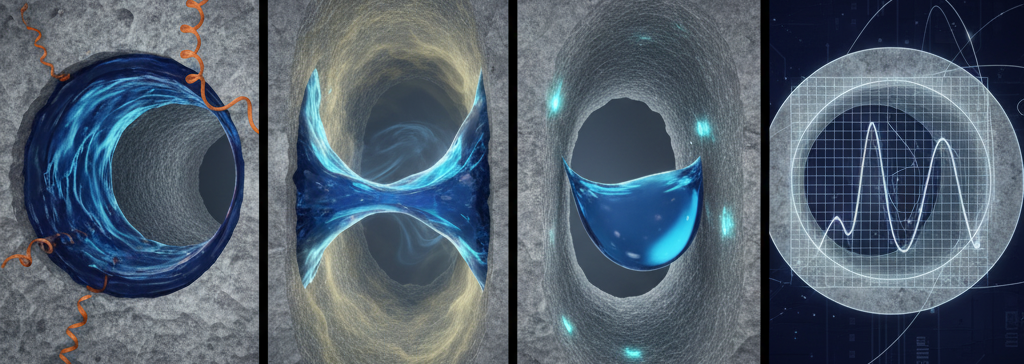
Liquids inside Nanopores
Our research group specializes in understanding and manipulating the behavior of liquids confined within nanoscale pores. By combining advanced molecular simulations with robust thermodynamic models, we explore the intricate interplay between fluid properties and the characteristics of the confining surfaces. This allows us to design and predict the behavior of novel nanofluidic systems with unprecedented control.
Expertise
- Molecular Dynamics (MD) Simulations: To study the dynamic processes of droplet formation, stability, and transport inside nanopores with complex geometries.
- Enhanced Sampling Monte Carlo Methods: We use specialized techniques like Grand Canonical Transition Matrix Monte Carlo (GC-TMMC) to accurately compute critical interfacial properties, including interfacial free energies and entropies.
- Analysis of Interfacial Fluctuations: We go beyond traditional energy-based analyses to explore the crucial role of interfacial entropy and density fluctuations. We can quantify how these fluctuations contribute to the overall free energy and thermal response of the system.
- Thermodynamic Modeling: We develop and apply thermodynamic models to predict the stability and temperature-induced motion of liquid droplets within nanopores.
- Design of Heterogeneous Nanopores: We have expertise in designing and simulating complex nanopores with tailored surface features, including variations in roughness, crystal structure, and chemical composition (wettability).
Applications
- Advanced Nanofluidic Devices: Creating smart “lab-on-a-chip” systems where fluid movement can be controlled simply by adjusting the temperature, enabling applications in analytics, diagnostics, and chemical synthesis.
- Energy Storage and Conversion: Designing materials for next-generation batteries, fuel cells, and “wetting engines” that convert thermal energy into mechanical work by harnessing changes in solid-liquid interfacial free energy.
- Subsurface Engineering: Improving processes like enhanced oil recovery, CO₂ sequestration, and hydraulic fracturing by understanding and controlling multiphase flow in the complex nanoporous networks of geological formations.
- Biomedical and Sensing Technologies: Engineering nanopores for highly controlled drug delivery, DNA/protein analysis, and biosensing, where temperature-responsive gating can regulate molecular transport.
Publications
2019: Transverse correlations near solid-liquid interface: Influence of the crystal structure of solid
2020: Can liquid density-fluctuations near solid surface drive the motion of nanoscale droplets?