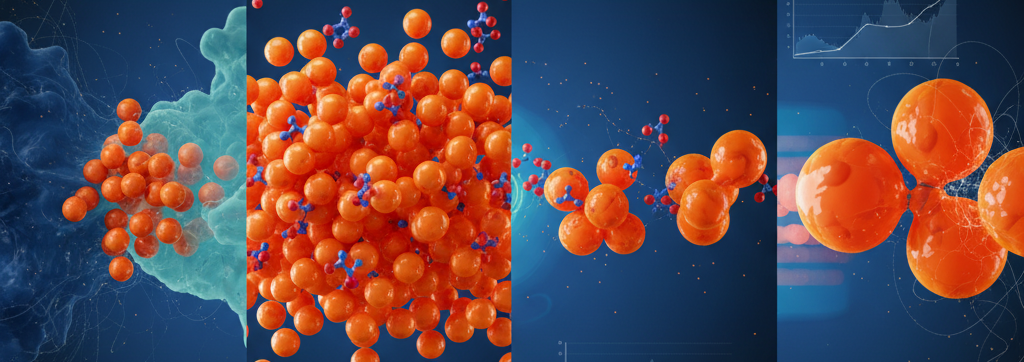
Nanoemulsions & Nanosuspensions
Our group specializes in using state-of-the-art molecular simulation techniques to unravel the complex phenomena governing the stability, structure, and phase behavior of nanoemulsions and nanosuspensions.
Expertise
We employ a suite of advanced computational tools, including Molecular Dynamics (MD), Grand Canonical Monte Carlo (GCMC), and Transition Matrix Monte Carlo (TMMC), to investigate these complex systems. Our core capabilities include:
- Predicting Stability and Phase Behavior: We simulate the conditions under which nanosuspensions remain dispersed or undergo aggregation and precipitation.
- Understanding Interfacial Phenomena: We analyze the crucial role of interfaces in multiphase systems. This includes studying the accumulation of surfactants and cosolvents at nanoparticle surfaces and calculating interfacial free energy.
- Designing Functional Nanomaterials: We explore how the performance of nanomaterials can be precisely controlled by tuning their molecular architecture.
Applications
The fundamental insights gained from our research have direct applications in several key industrial areas:
- Role of surfactants and ions: Our work provides a molecular-level understanding of how polyelectrolytes like polystyrene sulfonate (PSS), interact with hardness-causing ions (Ca2+) and surfactants (dodecyl sulfate, DS).
- Polymer Nanocomposites: Our simulations on nanoparticle aggregation and precipitation offer predictive insights into controlling this dispersion, which is essential for developing materials with enhanced mechanical, optical, and electrical properties.
- Wastewater Treatment: Understanding the mechanisms of nanoparticle aggregation and precipitation is vital for developing efficient processes to recover engineered nanomaterials from wastewater.
- Advanced Coatings and Formulations: We study how anisotropic nanoparticles self-assemble. This knowledge is applicable to the development of advanced formulations like waterborne latex polymer coatings, where particle aggregation behavior dictates final film properties.
Publications
2023: Effect of shape anisotropy on the precipitation of dimeric nanoparticles.