Simulation Methods & Data Analysis
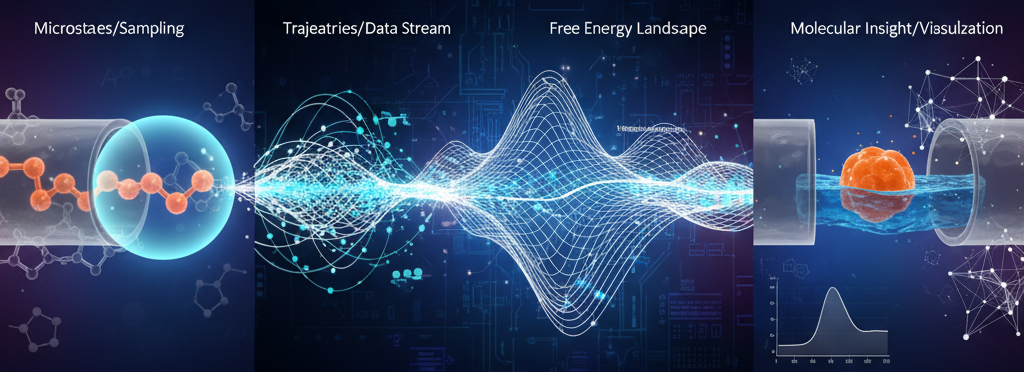
Our group develops and applies a powerful combination of advanced molecular simulations and data analysis tools to solve challenges in materials science and chemical engineering. By integrating statistical physics with modern data science, we create predictive models that can guide the rational design of polymer and nanoparticle formulations.
Expertise
Our expertise lies in creating and using computational tools to understand and engineer complex materials. Our core capabilities include:
- Advanced Monte Carlo (MC) Simulations: We develop and apply a suite of advanced MC techniques, including Transition Matrix Monte Carlo (TMMC) and simulations in the grand and semigrand canonical ensembles. The purpose of these methods is to overcome free energy barriers that are often insurmountable for standard simulation techniques.
- Predicting Molecular-Scale Heterogeneity: We specialize in developing computational frameworks to characterize and predict heterogeneity in complex materials from limited macroscopic data. This allows us to estimate the distribution of critical quality attributes that govern material performance.
- High-Performance Computing and Scalable Methods: Our simulation methods are designed for efficiency and scalability. We develop parallelized algorithms that can be effectively deployed on high-performance computing (HPC) systems, including multi-core CPUs and GPU architectures.
- Data-Driven Analysis and Process Optimization: We employ a range of data analysis tools to extract fundamental insights from our simulation and experimental data. These methods also help us to identify the most significant sources of variation and classify distinct subpopulations within a material sample.
Applications
The fundamental insights and computational frameworks from our research have direct applications in several industrial sectors:
- Design of Smart Materials and Formulations: We use advanced Monte Carlo techniques, such as Transition Matrix Monte Carlo (TMMC), to compute the free energy landscapes of polymers in complex solvent environments. This allows us to precisely predict the conditions under which a polymer will transition from a soluble, extended coil to a collapsed globule. These fundamental insights are crucial for rationally designing formulations where the stability and performance are dictated by the subtle interplay between polymers, solvents, and other additives.
- Biomolecular Engineering: The computational principles we apply to synthetic polymers are directly transferable to biological systems. The stability of biopharmaceuticals, for instance, depends on preventing protein unfolding and aggregation. By applying our advanced Monte Carlo simulation and free energy calculation methods, we can study the folding and unfolding pathways of biopolymers like proteins. This provides a molecular-level understanding of protein stability, which can guide the selection of excipients and the design of more robust and effective biopharmaceutical formulations.
- Precision Manufacturing & Quality Control: Our predictive models can aid the precision manufacturing of nanoparticle and polymer formulations for applications in pharmaceutical and other industry that are sensitive to heterogeneity in materials.